
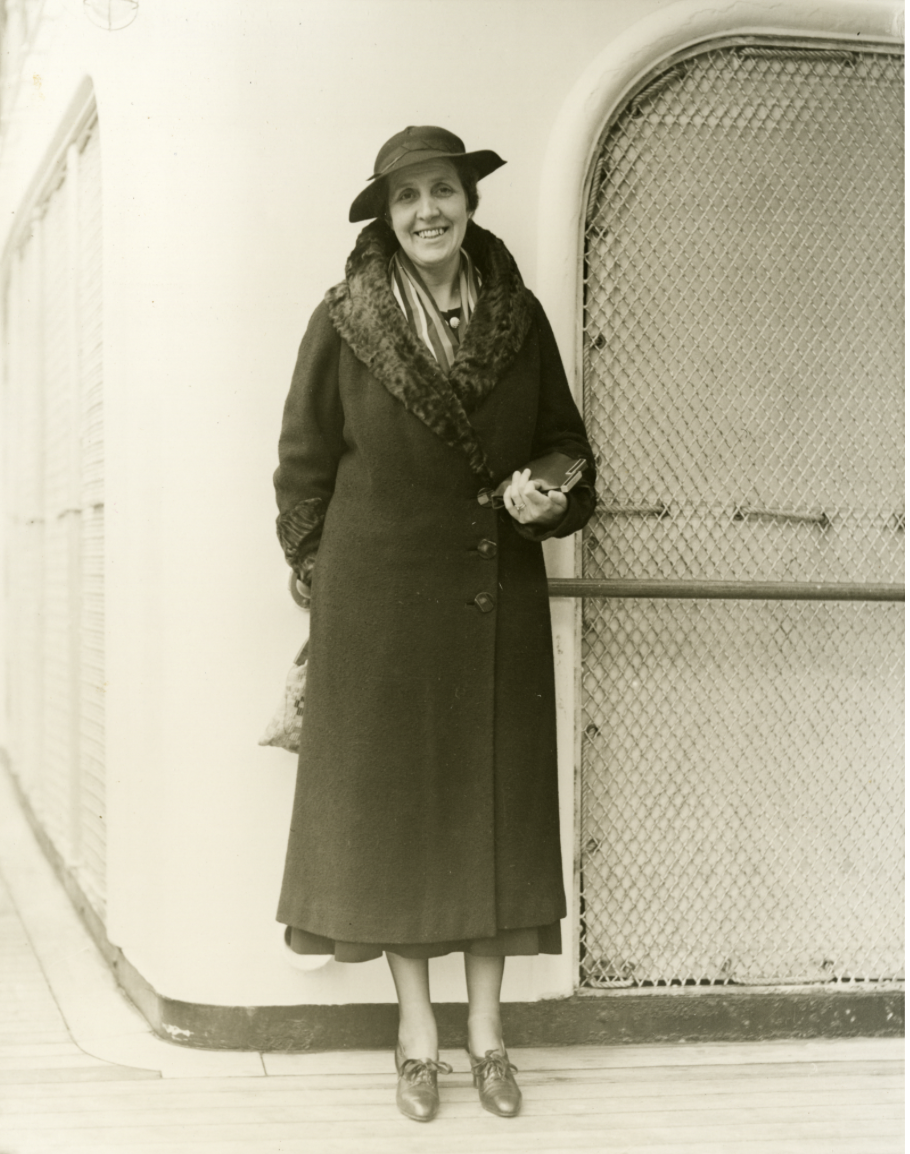
Full Name: Blegen, Elizabeth Pierce
Other Names:
- Elizabeth Denny Pierce
- Libbie
Gender: female
Date Born: 26 June 1888
Date Died: 21 September 1966
Place Born: Allentown, Allegheny, PA, USA
Place Died: Athens, Region of Attica, Greece
Home Country/ies: Greece and United States
Subject Area(s): Ancient Greek (culture or style), archaeology, and Classical
Career(s): art historians
Institution(s): American School of Classical Studies, Columbia University, and Vassar College
Overview
Art historian, archaeologist, and documenter of archaeological discoveries in Greece. Elizabeth Denny Pierce was born on June 26, 1888, in Allegheny, Pennsylvania (Pittsburgh area), to Flora McKnight (Pierce) (1858-1937) and William Lemmex Pierce (1860-1919).
Pierce did her undergraduate work at Vassar College from 1906 to 1920. In her freshman year at Vassar she met Ida Thallon [later Hill] (1875-1954), a professor in the Department of Greek and Roman Studies who taught her Greek and Latin. Thallon would go on to largely influence her academic interests as well as her personal life: the two women formed a close and perhaps romantic partnership that endured for the rest of Pierce’s life. Pierce went on to obtain her MA in Latin from Vassar, with a thesis on the intellectual life of Gaius Asinius Pollio, a Roman consul and historian. From 1912 she pursued graduate study at Columbia University, attending courses with James Rignall Wheeler (1859-1918) and Clarence Hoffman Young (1866-1957) on Greek architecture and sculpture. She took many courses taught by the historian George Willis Botsford (1862-1917), who also served on her dissertation committee until his untimely death; she completed her doctorate there in 1922, on the same subject as her master’s thesis.
From 1915 to 1922 she taught art history at her alma mater, Vassar College, and simultaneously served as assistant curator of the college’s Art Gallery, then housed in Taylor Hall, a post she held for seven years under the department’s long-serving chair, Oliver Samuel Tonks (1874-1953). Vassar had integrated the display and teaching of original works and reproductions from its founding, considering fine art a manifestation of moral truth. Her mentors in the Vassar classics department included Grace Harriet Macurdy (1866-1946), Catherine Saunders (1872-1943), and the Roman-studies scholar Elizabeth Hazelton Haight (1872-1964). She spoke English and French and had a scholarly command of Latin.
A 1921 trip to Greece with Ida Thallon redirected her career toward archaeology: the following year she attended the annual program at the American School of Classical Studies at Athens. Between 1922 and 1924 she was offered several positions, including an internship at the Metropolitan Museum of Art extended by Gisela M. A. Richter; although she declined the formal internship, she spent the spring of 1924 working with Richter at the Met. In the summer of 1924 she married fellow archaeologist Carl Blegen (1887-1971), a match that preserved her partnership with Ida Thallon: Thallon married Carl’s friend and colleague Bert Hodge Hill (1874-1958) in the same year, and the two couples subsequently shared a house in Athens. Elizabeth and Carl worked closely together for the remainder of her career: she excavated alongside him at Prosymna, Troy, and Pylos, and contributed to the publications resulting from these excavations, in addition to cataloguing finds. She also assisted Bert Hodge Hill’s excavations in Cyprus.
Even as her career turned toward field archaeology and, from 1925 to 1952, toward writing the “Newsletter from Greece” reports for the American Journal of Archaeology, her training as an art historian continued to inform her published work. Her 1922 article “A Roman Colony in the Alps: Aosta” and her 1942 essay “Recent Discoveries on Roman and Greek Art,” published in the Gazette des Beaux-Arts, are both works of close visual and stylistic analysis rather than excavation reporting. This same connoisseurial habit surfaces repeatedly within her ostensibly archaeological “Newsletter” reports, where she consistently singles out sculpture and painted pottery for closer stylistic treatment than other classes of find.
She is also recorded as having lent objects of art to the Metropolitan Museum of Art. She was a member of the American Philological Association.
Elizabeth Pierce Blegen died in Athens on September 21, 1966, and is buried in the Protestant section of the First Cemetery of Athens.
Selected Bibliography
- “A Roman Man of Letters, Gaius Asinius Pollio.” PhD diss., Columbia University, 1922.
- “A Roman Colony in the Alps: Aosta.” Art and Archaeology 13 (1922): 83-90.
- “A Daedalid in the Skimatari Museum.” American Journal of Archaeology 28 (1924): 267-75.
- “Jewellery and Ornaments.” In Prosymna: The Helladic Settlement Preceding the Argive Heraeum, by Carl W. Blegen. Cambridge: Cambridge University Press, 1937.
- “Recent Discoveries on Roman and Greek Art.” Gazette des Beaux-Arts (November 1942): 63-76.
- Review of Studies in Honor of Frederick W. Shipley by His Colleagues. American Journal of Archaeology 47 (1943): 360-61.
- “Archaeological News: Classical Lands, Greece.” American Journal of Archaeology 55, no. 2 (April 1951): 157-66.
Sources
- “Elizabeth Pierce Blegen.” Wikipedia. https://en.wikipedia.org/wiki/Elizabeth_Pierce_Blegen.
- Elizabeth Pierce Blegen Papers, GR ASCSA EPB 002. Archives, American School of Classical Studies at Athens. https://www.ascsa.edu.gr/index.php/archives/elizabeth-blegen-finding-aid.
- Elizabeth Pierce Blegen, Vassar College Student Scrapbook. Vassar College Digital Library. https://digitallibrary.vassar.edu/collections/other-collections/vassar-college-student-scrapbooks/ea1909e8-d6c5-4f83-b0be.
- “The History of Greek and Roman Studies.” Vassar College. https://150.vassar.edu/histories/greek-and-roman-studies/index.html.
- Langridge-Noti, Elizabeth. “Elizabeth Pierce Blegen (1888-1966).” In Breaking Ground: Women in Old World Archaeology. Providence: Brown University. https://webhelper.brown.edu/joukowsky/Breaking_Ground/bios/Blegen_Elizabeth%20Pierce.pdf.
Contributors: Inaya Shafi